
Fast China Factoid
It's not always about the EVs...

We have a longer more substantive post in the the works, but for now just one simple chart on the Hot Topic of the Day, Chinese EV Exports. We’ve all read the stories (including some posts on this blog) about excess Chinese EV manufacturing capacity, the wave of Chinese EV exports, the tariff walls designed to block Chinese EV exports coming up in Europe and the USA, the incredible pace at which Chinese EV models are updated, etc.
All of this is important stuff and the core observation that these EVs will represent a massive challenge to “Western” incumbent car companies is very accurate.
But one small corrective to the narrative as it stands today: most Chinese light-duty vehicle exports at present are gasoline powered (aka ICE, internal combustion engines). From the Economist:
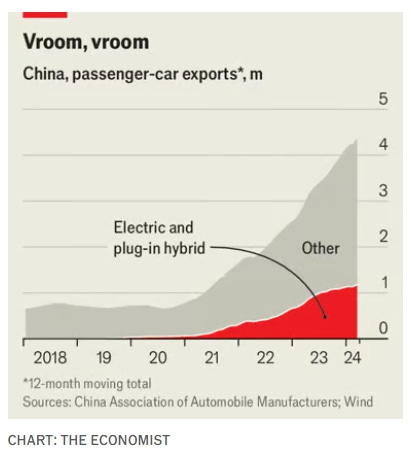
We get so caught up in the onrushing EV transition (which in no way do I dispute or doubt) that we tend to overlook data that points in any different direction. But right now, at least, Chinese passenger-car exports are mostly ICE, and the share that is ICE is growing faster than the EV share.
One driver of Chinese ICE exports is the Russian market, which is soaking up cars from China as supplies from OEMs based elsewhere recedes, due to the invasion of Ukraine. And Russia is mostly ICE at present. Another driver is relative excess capacity: as domestic demand in China for EVs soars, more and more ICE capacity is left idle, and thus seeks export markets as a way to keep the factories moving. And another is the Inconvenient Truth is that outside North America and the EU the demand for ICE cars is very robust: in places like Colombia, Costa Rica, or South Africa EV penetration in 2023 was well under 2%, according to the EIA… and much of China’s export wave heads towards countries such as these.
Again, this will all change. The China EV export wave is real. However, it is perhaps useful to keep in mind, while analysts and politicians and journalists are all in panic mode about Chinese EV exports, that - in the short term at least - it is boring old petroleum burners that dominate China’s car exports. Again, inertia is a powerful force in the automotive world.