

(With apologies to Liam Neeson for mangling his famous movie line, and with thanks to Jalopnik for leading me to this study.)
Throughout the history of the automobile there has been debate about car prices, specifically in today’s case as to whether fixed (“no-haggle”) or variable (negotiable) prices are optimal, from the point of view of the customer, or the dealer, or the car manufacturer. Some observers have asserted that the tradition of haggling price reaches all the way back to when horses were the dominant form of personal mobility (other than walking), since the price of horses was almost always subject to negotiation - in large part because the quality of the horse was not immediately obvious to the buyer (or seller)1.
But haggled prices were more the rule than the exception for all goods in America until around 1900 or so. It was only in 1823 that A. T. Stewart opened his “fixed prices” dry-goods store in New York City, and in 1861 when Wanamaker’s in Philadelphia pioneered the idea of a price tag affixed to individual items.2 But certainly over the last century fixed prices have become the norm - ever try to haggle with Amazon? - though not necessarily in the world of cars.
There are many reasons for this, including for example the complexity of the deal. For example, most (about 75%) of new cars in the USA are sold on lease or loan financing, and about half the time with a trade-in (part-trade) involved, so that the monthly payment for the car (the number most buyers focus on) can vary immensely depending on loan term, trade-in price, lease residual value, etc. There is not just the one price to negotiate over.
Against this backdrop of negotiated prices we have of course consumer attitudes towards them. The eternal tension in the customer’s mind is between the benefit of haggling (getting a lower price) and the cost of haggling (in terms of, for example, the extra time spent arguing with the salesperson, the emotional toll of the process, the eternal dread that you could have gotten an even better deal if you had tried harder, etc.).
Generally speaking, as Americans have become wealthier in terms of both income and assets, their willingness to haggle has receded: when you can only afford one car (say, around 1960) you needed to make sure you got a good price. Today, with almost three cars in the average driveway, the economic stress is lower, and so the pain of haggling less worthwhile.
Which brings us to the current day. A few weeks ago a major national newspaper ran an article on variable versus fixed car prices, and noted that for some people there was such an aversion to haggling that they were happy to pay more for their car, just to avoid the process.3 And the general sense of the zeitgeist today in the USA is that more and more people are averse not only to haggling, but even to the interpersonal contact that haggling requires. See preferences for robotaxis (to avoid having to talk to a driver), direct-to-room hotel check-in (to avoid having to talk to the front-desk clerk), home meal delivery (to avoid having to interact with waitstaff), etc.4
Which brings us to today’s chart, which takes a shot at estimating just how much a typical American car buyer would pay in order to avoid haggling over the car’s price. We turn here to Beyond Propensity: Thresholds, Costs, and Interventions in Negotiation Avoidance, by Hunsaker, Zhang , and Lee. (As always, please read the actual paper to determine how much I may have unintentionally garbled or over-simplified their results, and to see the details of their methodology.
Amount Willing to Pay Above Car’s Average Price to Avoid Negotiating
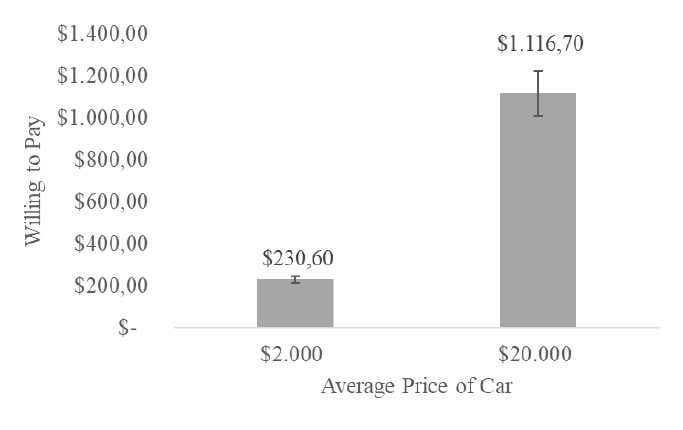
Interpretation: $230 and $1,117 are the amounts that car shoppers surveyed would pay to avoid negotiating, the former amount for a $2,000 (typically used) car (on the left, 11% of the price), and the latter for a $20,000 (typically new) car (on the right, 6% of the price.) (Gotta love academics, not rounding to the nearest dollar!)
(Hey students, note the varying scales of the absolute dollar amounts and the relative percentages: discuss.)
Given a buyer might spend 2 hours in the new-car store getting the deal done, this translates to $500 an hour or so to just not have to talk price. This is a striking finding, given how financially stressed car buyers seem to be nowadays (no worries, I won’t mention the A-word again), such that they’d give up a grand just to avoid a (potential) argument.
Now of course, there are various caveats to apply here. First is that this is stated rather than actual behavior: when push comes to shove the haggling-averse might take a deep breath and open negotiations over the Straits of car price. Second, the survey here is just about an abstraction called “car price,” which excludes all the messy details about trade-in values, financing terms, etc. And third, the results are spikey in that the average conceals the fact that about half of respondents would never pay anything to avoid haggling. So it is a matter of customer segmentation - maybe we’d call them the Extroverts and the Introverts.
Also, in my experience, this all depends on exactly how haggling is perceived, and how the haggling question is asked. One can imagine different responses to:
“Do you want to spend 90 minutes in a stuffy cubicle arguing with a sweaty salesperson and his or her manager over the last $100 of price?”
“Is it important to you, as steward of your family’s finances, to ensure that you negotiate for a fair and reasonable price for your car?”
However, my overall take is that these results are generally correct, and that they also predict the future (my interpretation, not the authors’!) in that over time the percentage of new (and to a lesser extent, used) cars whose prices are negotiated will only continue to fall, and that more and more dealers will be moving in this direction - since (my) implication from the study is that they won’t lose as many customers as they so move. What was once unheard of - see the 1990 launch of Saturn, which astonished the nation with its no-haggle prices - is now increasingly common and likely to become more so. And we have at least two powerful groups of industry influencers pushing ahead in this direction: the no-haggle used-car chains like CarMax and Carvana5, and the DTC (direct to customer) new-car firms like Rivian and Tesla.6
I’d go on more about this but I am already a little uncomfortable talking to you people, and besides, the DoorDash guy just left my Chipotle order on the front step — I’ll wait until he’s gone before I open the door.
(One more caveat: there are definitional issues around fixed / no-haggle / non-negotiable / etc. prices, so be careful. For example, a CarMax store or a franchised dealer may state that they do not haggle, but that does not mean they do not change prices. A car listed for $20,000 today (with no room to haggle) may be listed for $21,000 tomorrow (again, with no room to haggle). Fixed prices need not be fixed over time!)
UPDATE: A very germane article about Carvana just came out here.
See for example this list of tricks of the horse-dealer’s trade in America in the 1800s and early 1900s, including “bishoping” and “gingering.”
As almost always, however, when it comes to the history of innovations, it is very likely that other - now unknown - merchants pioneered similar concepts earlier and elsewhere.
One irate shopper stated he would pay “a few thousand” dollars just to avoid haggling, and I wanted to reach out to him and assure him that if he walked into a dealership and announced this preference, the salesforce would be only too happy to oblige!
Obviously aversion to personal contact is not the only reason for choosing these options (e.g., home food delivery saves you the drive to Larry’s Clam Shack), but it is clearly a leading motivator.
Which, by the way, do alter prices on the financing, according to individual customer characteristics! They (in a way) haggle on the financing price, but not the car price.
But note, there is nothing inherent in the DTC model that forces these companies to set one price for all customers everywhere. They have chosen to implement “no haggle," “one price to all customers” and “direct to customer” (those are three different things) at the same time, but they did not need to. Take Starbucks for example: they use a DTC model (with exceptions for licensed stores in locations such as airports), and yet their prices vary widely by state. See for example here.