
Just One UAW Chart
A quick post on a key topic

We interrupt our regularly scheduled programming to bring you… one chart that provides clarification for some of the numbers being thrown around about the current UAW strike. I think 90% or more of my readers know this stuff, but just in case, here we go, a lovely summary by ace Wells Fargo analyst Colin Langan (one of the very best: read his research!). The main point to make is that wages do not equal compensation, and compensation does not equal cost to employ!
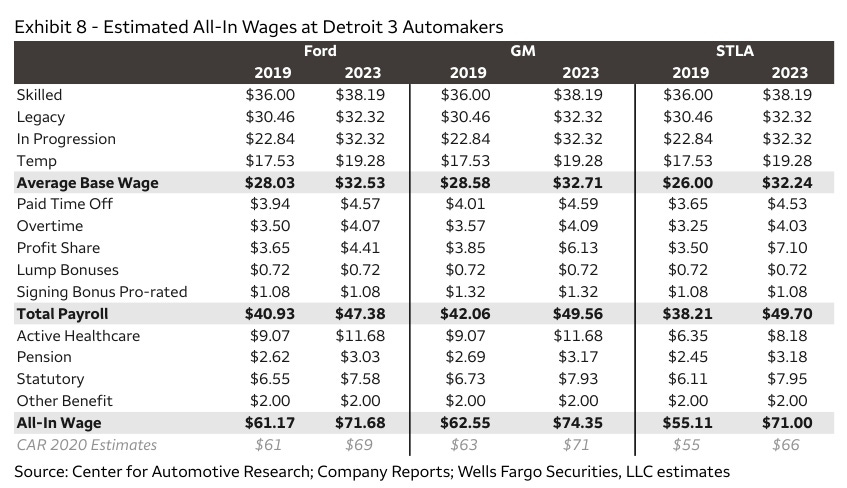
(Note that his numbers vary somewhat from those put out by the excellent Center for Automotive Research in Ann Arbor, but they’re close enough. Kudos for Colin for including them.)
The way I have always interpreted these digits is as follows (and any errors here are my own, not Mr. Langan’s), using Ford in 2023 just before the strike:
WAGES are what a typical workers would say “I am paid per hour.” (The $32.53 is the weighted average of the four main tiers listed above it.) Call it $32.50.
PAYROLL is what a worker might say “I get from the company over the course of the year.” PTO (for a senior worker this can be 5 weeks of vacation and 16 or 17 holidays), overtime, profit sharing payouts (paid in an annual lump sum but here spread over annual hours), and various bonuses (e.g. the bonus to sign the contract 4 years ago, spread over the intervening years). Call this $15. Now we are at $47.50 per hour.
ALL-IN-WAGE is what the company might call “my cost to employ a worker.” Some of this benefits the worker, but not in the form of cash (e.g. health care), some is just something the OEM must pay (e.g. payroll taxes). Call it $24, the largest portion of which is health care. (Note that pensions are not accrued to all employees: this is just the total cost of pensions for those workers who ARE in the plan, spread across all workers.)
Grand total is thus $71.50.
It is hard to compare UAW wages to other non-union auto workers, because we don’t have this level of detail for the latter. But when you do see a number for a Toyota or a Tesla, remember to keep the above chart in mind, and ask “Which aspect of compensation are you referring to?”
Because the selection of aspect is key. If I focus on wages, a union worker might say “We’ve only gone up $4.50 in 4 years!” But if I look at total compensation, a CEO might say “Our cost has shot up $10 in 4 years!”
Perspective, and definitions, are crucial.
DISCLAIMER: Nothing in this post should be interpreted as my taking a stance on whether these numbers are right or not (I believe they are, but they are not my calculations), whether they represent fair pay or not, whether the UAW is “right” or whether management is “right,” etc. I am only trying to clear up the confusion that arises when one person says “Ford pays $32 an hour!” and another says “No, they pay $47!” It’s hard to have a good debate when people are working from different starting points (even when both points are correct in their own way).