
Quick Hit #3: Affordability AGAIN
We'll never get tired of talking about this?

Again, is there a new-car affordability “crisis” or just an affordability “challenge”? Majority opinion in the industry is there is a crisis, as in: customers are over-extended, subprime risk is soaring, negative equity is out of control, a crash is coming, new-vehicle sales will sooner or later plummet. My opinion (in the minority) is that indeed consumers are over-extended, but not to an extent we have not seen before, and that sales rates will indeed fluctuate but we are unlikely to see a crash.1 I see challenge where others see crisis.
There are many ways to look at this debate, from credit scores to loan terms to weeks-of-income-to-buy-a-car to sunspots and beyond. I’m going to just look at inflation generally, and two car price series, all set to “zero” in 2012:
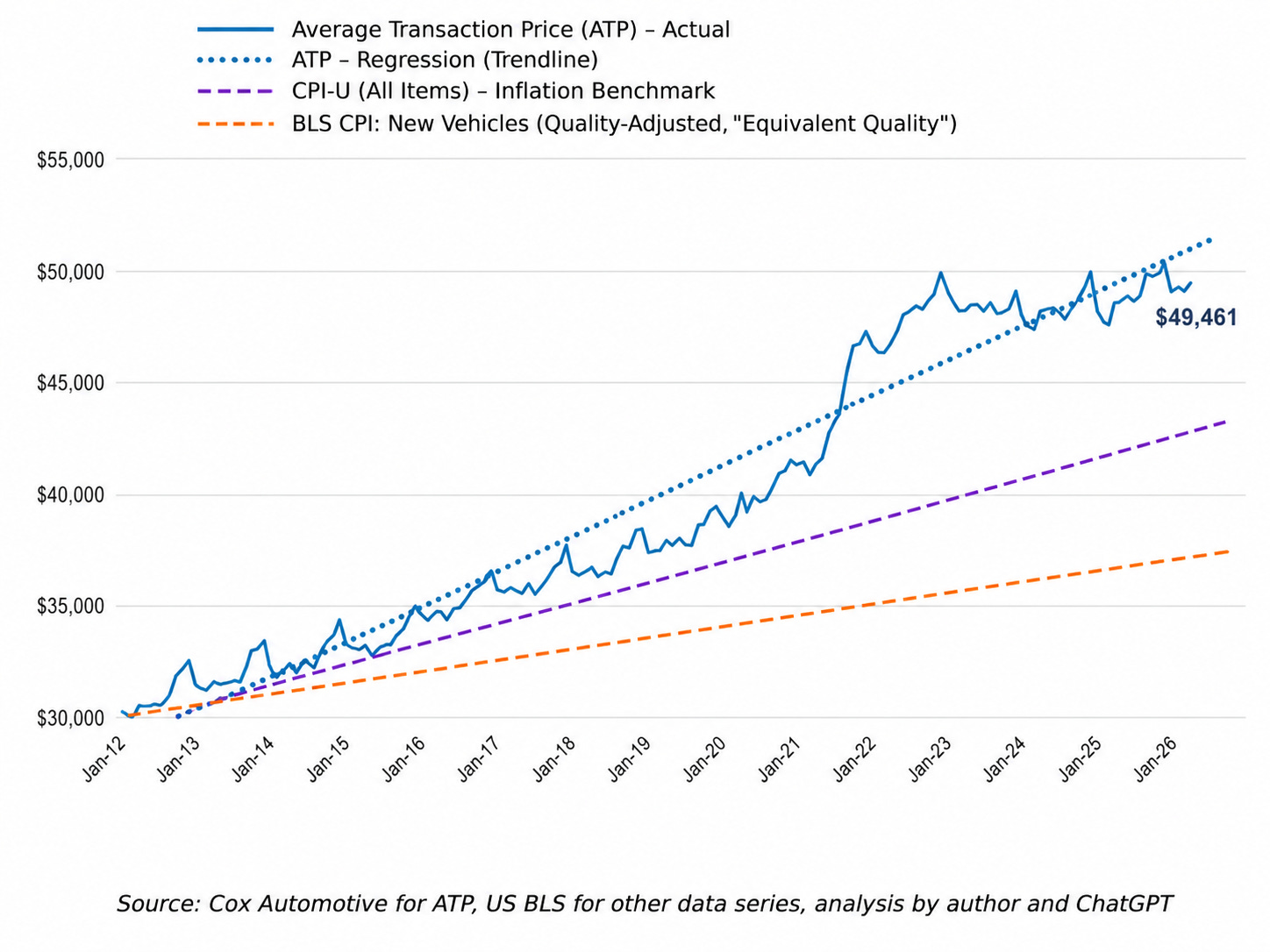
What are we looking at here? The blue jagged line is actual average transaction price (ATP) for new cars in the USA (thank you, Cox) with a regression line from 2012 to now overlaid for comparison’s sake. The purple line is general price inflation, in this case CPI-U (thanks, Bureau of Labor Statistics). The yellow line is BLS’s estimate of price of a new car with quality held constant, “quality” defined here broadly, including reliability, durability, safety, fuel economy, maneuverability, speed, acceleration, braking distance, carrying capacity, comfort, and convenience.2
The yellow and purple lines’ slopes represent their two rates of inflation, but I linked their left ends to the $30,000 level of the ATP, so they can be compared.
My conclusion? The constant-quality car benchmark has increased in price by less than inflation (the yellow line is below the purple line). Buy the 2012-equivalent car in 2026, and it has gotten relatively cheaper. But the price of what people are actually buying in 2026 is well ahead of inflation, in large part (IMHO) because those vehicles have been dramatically upgraded in terms of reliability, durability, safety, etc. etc.
To put it starkly and simplistically: affordability issues are in large part the result of customer choices, not inescapable inflation imposed by external forces.
You may say “No, all this stuff is forced upon us, thus inflating prices.” And yes, you would be in part correct. We have seen a mix shift to bigger/better/faster vehicles, and that shift is indeed produced jointly by consumer demand, OEM product strategy, regulation, and consumer expectations for safety and technology features. It’s a matter now of figuring out which factors dominate.
If you’re paranoid about big business, you’d lean towards OEM feature push being the villain (“No one wanted power windows, you seduced us to giving up manual cranking with your incessant advertising!”). And yes, the OEMs have trimmed back cheaper models - but wouldn’t you, too, if you were in charge? Would you rather sell 17 mm cars in 2019 (before the latest price run-up) for $40,000 a pop, or 16 mm this year at $50,000 each? (You do the math, reader!)
If you’re not impressed with your fellow man, you’d say it is customer pull (“Hey buddy, do you really need a Wrangler Rubicon, when the last time you went off road it was to park on the lawn at the kid’s soccer game?”).
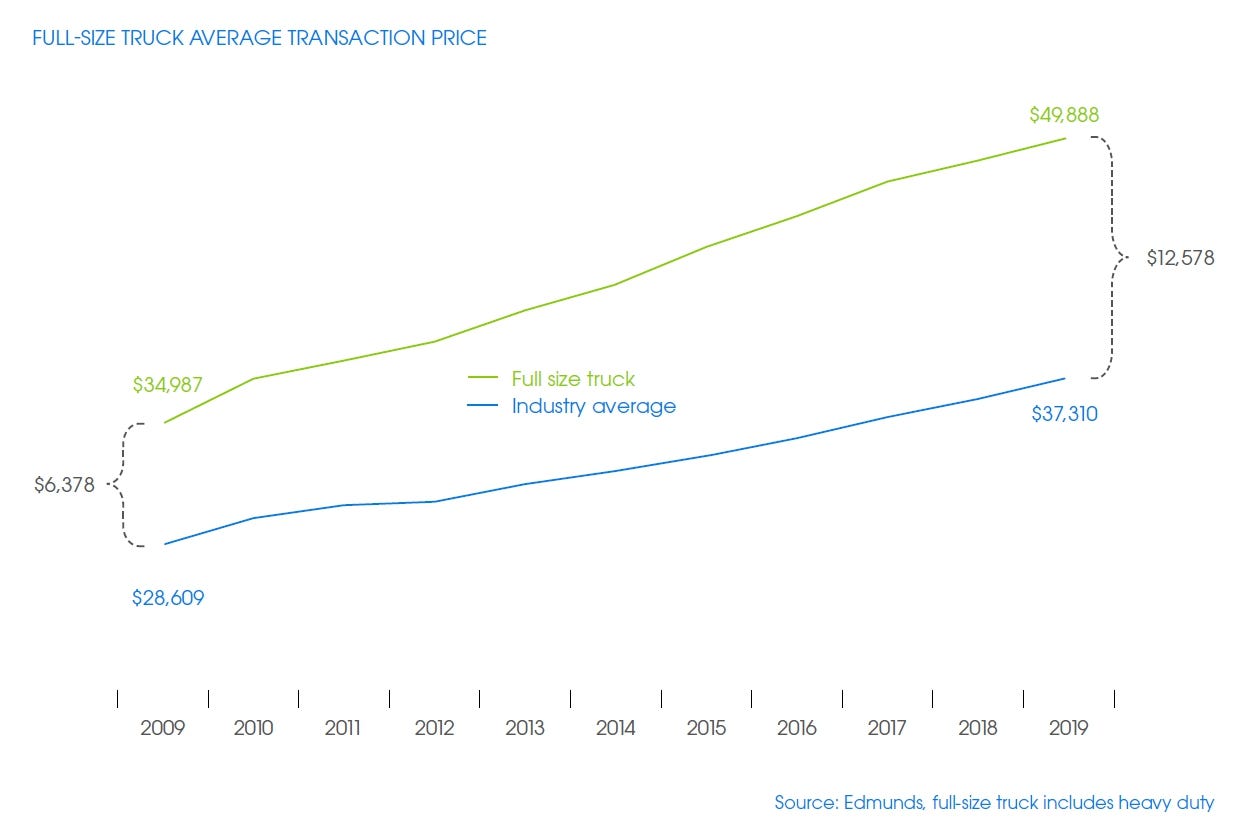
But here’s some evidence it is pull rather than push: apologies that this is dated (Edmunds, 2020 or so), but if we look at pickup truck base prices against as actually-spec’d prices, we can see a huge gap, and it is primarily due to options loaded on to the base truck3…. as selected by customers.4
And you can rail about regulation forcing choices on the public, for better or worse.5
This debate will never end, of course, in part because there is no one right answer, but a complex answer with many moving parts. I welcome input from the hundreds of price and product planners at the OEMs, and the researchers at esteemed firms such as J D Power, Cox, Edmunds, Strategic Vision, and many others, to correct my views (with better data, not just different opinions). But in the meantime, I will stand by my conclusion that We The People are in some large part responsible for this. If you really want a good cheap basic car without power anything, or a backup camera, or even airbags, well, there is always this.6
A real-world test for both sides of this argument will come from Slate, once they launch7. Will buyers opt for the bare-bones trucklet, or load it up with bling?
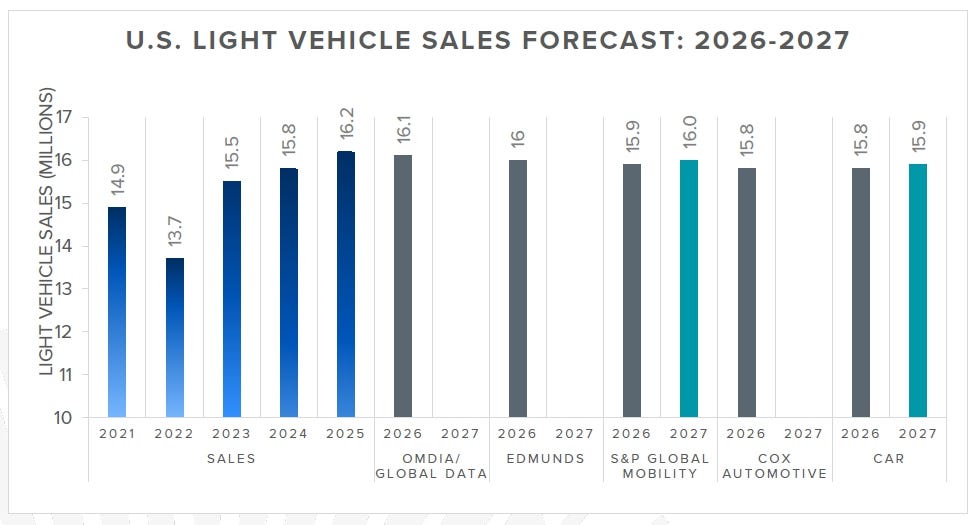
But for now, even forecasters other than, and better than, yours truly don’t see much of a hit in 2026 and 2027 to unit vehicle sales from these high prices (thanks, Alliance for Automotive Innovation). The K-shaped car market has spoken, and it has chosen Whole Foods, not Aldi.8
As you read this please keep in mind my forecasting track record. “Stellar” is not the word to describe it. In automotive, I thought F&I per new unit retailed could not go over $500. Oops. In other areas, I thought Fleetwood Mac would remain a niche British blues band, and that we’d never see Lana Del Rey again, after her SNL disaster. Also, I sold what Bitcoin I ever owned at the $1,000 level. So proceed at your own risk!
Excluded are more cosmetic changes like paint colors, styling changes, trim additions and deletions, etc.
No, this is not dealer markup above MSRP, this is options loading. The chart compares base MSRP against fully-loaded MSRP. Transaction prices will be variably higher or lower.
And further, to quote a real expert, not myself: “Many new-car buyers today are in their peak earning years and are less price-sensitive, opting for vehicles at the higher end of the market to get the features and experiences they value most. In November [2025], sales of vehicles priced above $75,000 outpaced those below $30,000, underscoring this preference for premium products.” (Erin Keating of Cox). This analysis refutes the notion put forward by some, that we’re buying expensive cars only because there are no cheap ones out there, instead implying that customers themselves are opting for higher price tags.
I had an uncle who thought seat belts were for Communists, and yes he actually said once in my hearing: “If I get in a crash I want to be thrown clear through the windshield, not strapped in my seat to be crushed.”
And just a reminder: this car had a 14-second zero to sixty time. Still want it?
As I understand it, the basic, cheapest Slate pickup will have no power windows, no infotainment screen, no speakers, and the composite body panels will be unpainted.
No offense to Aldi. I personally am a frequent visitor to the Aisle of Shame.