
Sometimes economics does work
Specifically, the price elasticity of demand

This week’s Intel Report from the inimitable Steve Greenfield over at Automotive Ventures summarizes and links to a great Bloomberg article on Singapore’s ongoing efforts to reduce traffic delays, specifically the latest upgrade in the city-state’s half-century-old congestion pricing scheme.
(In brief, the country is moving to a satellite-based system that will more accurately price road usage, reducing the distortions caused by fixed gantry-type scanning systems. For example, in the words of an official at Singapore’s Land Transport Authority, “Someone whose destination is just 15 meters after the pricing gantry is charged the same as someone who went on the highway for two or three kilometers” further. Satellite tracking will be more precise, and thus more fair.)
It is absolutely certain that congestion pricing has dramatically reduced traffic in this crowded country. But, as the article mentions (and then links to another Bloomberg report that goes into this in more depth), the government has also pulled a more direct lever to cut down on congestion: hiking the price of cars, via taxation. Just how a hike are we talking about? Well (using current exchange rates to translate from SGD to USD), a Toyota Camry Hybrid that might go for $40,000 in the US or Europe, in Singapore would run you about $140,000. No typo. The extra 100 Clevelands1 goes to various taxes but especially to the COE, the Certificate of Entitlement, the price of which is set in twice-monthly auctions. Should you wish to bid on one yourself, here is the website.
Which brings us to our present chart, courtesy of Deutsche Bank’s current Mapping the World’s Prices report2. They took as a global standard car a VW Golf 1.5 or equivalent3. So how expensive is it to buy a car in Singapore?
Prices of Volkswagen Golf 1.5 (or equivalent new car, USD)
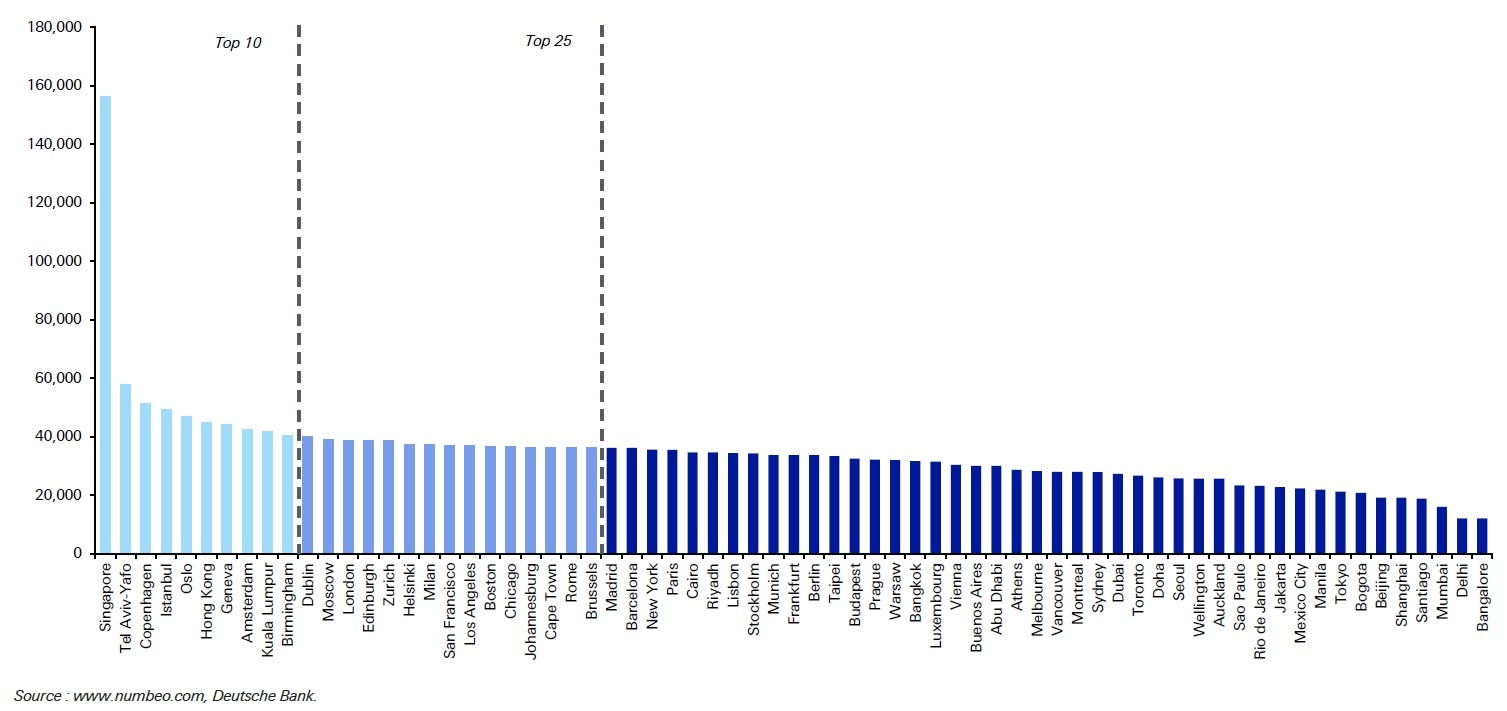
Yeah, Singapore FTW!4 So, while congestion pricing is doing its part to reduce traffic on the roads in the Lion City, simply cranking the cost of a car sky-high serves to reduce the number of cars on the roads in the first place. How much of a reduction? Well according to Wikipedia the wealthy nation of Singapore has a vehicles-per-capita ownership rate of about 170 (110th place out of 175 nations), putting it in company with much-lower-income nations like Peru and Tonga.5 (The USA is at 800 and even bike-wild Denmark is near 5006.) Frankly, given the eye-watering car price level, the ubiquitous road tolls, and gasoline at nearly $9/gallon, I’m amazed they get to 170.
Remember this chart the next time car “affordability” comes up in conversation.
You didn’t know that the long-discontinued US $1,000 bill at one point featured President Grover Cleveland’s portrait? He was one of the few US Presidents who served two terms (22 and 24), separated by that of a rival (in this case, Benjamin Harrison). You may know of another such President.
It is a fascinating read, not least for its Cheap Date index, which compares the local cost, in various cities, of what DB considers the essentials of a … cheap date: “1 bottle of wine, 1 pair of jeans, 1 dress, 2 coffees, 1 meal for 2 people in a mid-range restaurant, 2 cinema tickets, 2 transport tickets one way, and a 5km taxi trip.” I would have loved to have been on the research team that put this index together. Presumably you need the new pair of jeans and the new dress just for the one date, because in your shared cab ride the driver hit a speed bump too hard and you spilled the wine and coffee on yourselves? Beats me. For what’s it worth, among the cities ranked in the index Geneva and Zurich are the “winners:” there this would-be cheap date will run you $450, so I’d suggest instead investing $300 in two return flights on Flyadeal (yes, really) to Cairo and wowing your date there, for the same total price - as the date in Egypt will run you only $150.
This is the kind of free romance advice other Substacks do not offer.
The way the bad news is rolling out of Wolfsburg these days, I am not sure how much longer the Golf will be a global standard. Personally I would have picked as a benchmark the Swift, since Suzuki is the great overlooked success story among global OEMs, IMHO. The boys from Hamamatsu for decades now have been annually cranking out a few million Swifts or their equivalents (Alto’s, e.g.), not to mention the delightfully-monikered Fronx. And they get no respect. Yet arguably this firm, specializing in cheap wheels, has brought more mobility to more low-income nations than any other OEM.
I do try to keep current with modern online lingo. It’s really fab.
Showing great cultural insensitivity, I ask “Where does one even drive in Tonga? The country is less than 300 square miles! Spread around some 45 inhabited islands!” But then again, tiny Bermuda, which you can walk entirely around in just a day, has by my count half a dozen car dealerships. Humans and wheels! We must remember, when America sent men to the moon, they sent a golf cart with them. The astronauts traveled 250,000 in the vacuum of space… so they could drive around?

(“Gotta remember… clutch in… ease on the gas… clutch out… damn! Stalled!”)
Bizarrely enough, the leader in this league, leaving aside geographic oddities like Andorra and San Marino, is not the car-crazed USA, but… New Zealand? Maybe the sheep can get licenses?