
Two of Five
A very boring but very important chart

Economists, pundits, analysts and more love the “peak” concept, which can be applied to virtually any phenomenon which unfolds over time. Are we at Peak Globalization, as countries pull back their global supply chains? Are we at Peak Oil, at which point crude production will begin to decline?1 I am pretty sure we have passed Peak Avocado Toast. But, this being an automotive blog, what about Peak Car?
In trying to answer that question, one first has to define terms. Do we mean peak car ownership (e.g. number of cars in the average household)? Peak miles driven? Peak numbers of cars on the road? And for all three (and there may be more varieties of “peak”), are we talking about absolute or relative peaks? E.g. if the fleet grows while VMT (vehicle miles traveled) stays stable, we are not yet at Peak Fleet (absolute) but we may have hit Peak Miles per Car (relative).
As one can imagine, there is a whole cottage industry out there of academics and policy-makers analyzing Peak Car, unfortunately often with an ideological axe to grind. I won’t go into, here, all the various formulations and arguments, and will focus on just the Peak VMT metric, and just on the USA for now.2
So here’s the chart, presented today, since just this week the US government released December 2025 data, so that we have the full calendar year:
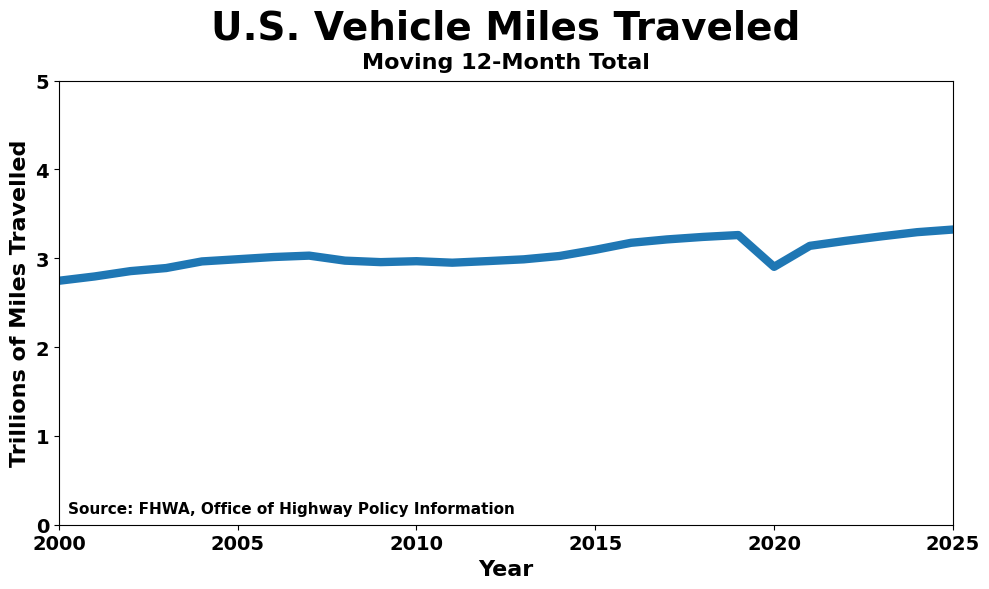
This is the gross total of miles covered by vehicles on America’s roads each year. It includes all categories of vehicle, from cars to trucks and even motorcycles. And your eyes do not deceive you: that it Trillions of Miles on the Y-axis.
On this absolute VMT level we have not yet hit Peak Car: we’re at a record 3.32 trillion miles in 2025, up 21% from 2.75 in 2000 (with a pandemic dip clearly visible). But on a relative basis we may have peaked: the population is up 23% over this timeframe, meaning VMT per capita has edged down. The same for VMT per vehicle, as the vehicle count is up about 30%. And relative to economic activity we definitely have hit Peak Car, as GDP has just about tripled since 2000. So any link between economic growth and miles driven has clearly been broken.
From an industry perspective, the absolute total VMT probably matters most, as miles drives wear, and wear drives repair and maintenance work and, ultimately, new sales. And that is still - slowly - growing. But on a relative basis, yup, we have probably passed Peak Car.
Class assignment: what are the causes for the relative decline in vehicle use? Candidate theories include (swiped from Wikipedia but edited and commented on by yours truly):
The Marchetti Constant? I will post on this soon, but the concept is that people will tolerate spending only so much time traveling per day. So as their wealth increases they do not spend more time traveling, but shift to faster modes. Middle Ages in Europe? Walk. Early 20th Century in the UK? Take the train. 1950s America? Drive. 2025 America? Fly. At the expense of driving.
The growth of public transport? Not in the USA, not significantly.
The reversal of urban sprawl and other population shifts, from suburbs to cities? Not in the USA, sorry. We’re a nation of suburbs.
High fuel prices? Again, not in the USA. And besides, the improved fuel economy of modern cars eases the pain of gas prices.
Increasing costs of automobile ownership? Possibly, though it seems to me this would affect ownership more than mile driven per car (e.g. insurance costs are high but tend to be fixed relative to miles covered). And cars per capita (ok, not the same as vehicles per capita) has been stable in the USA.
Rise of ridehail or carshare, etc.? Nope. I covered this.
Cultural shifts whereby young people don’t get their licenses? Not really a factor if you look across a lifetime: young people in the USA are getting their driver’s licenses later in life than before, but older people are driving longer (e.g. into their 70s and 80s), and so total driver’s license counts in the USA are still going up.
Economic factors, particularly unemployment? Well, the economy seems pretty darn healthy.
Growth of e-commerce? Just have Amazon deliver the shopping and DoorDash the food? Probably, on a relative basis, but not enough of an effect on the absolute scale. And note that Amazon and DoorDash both need vehicles.3
I welcome your hypotheses!
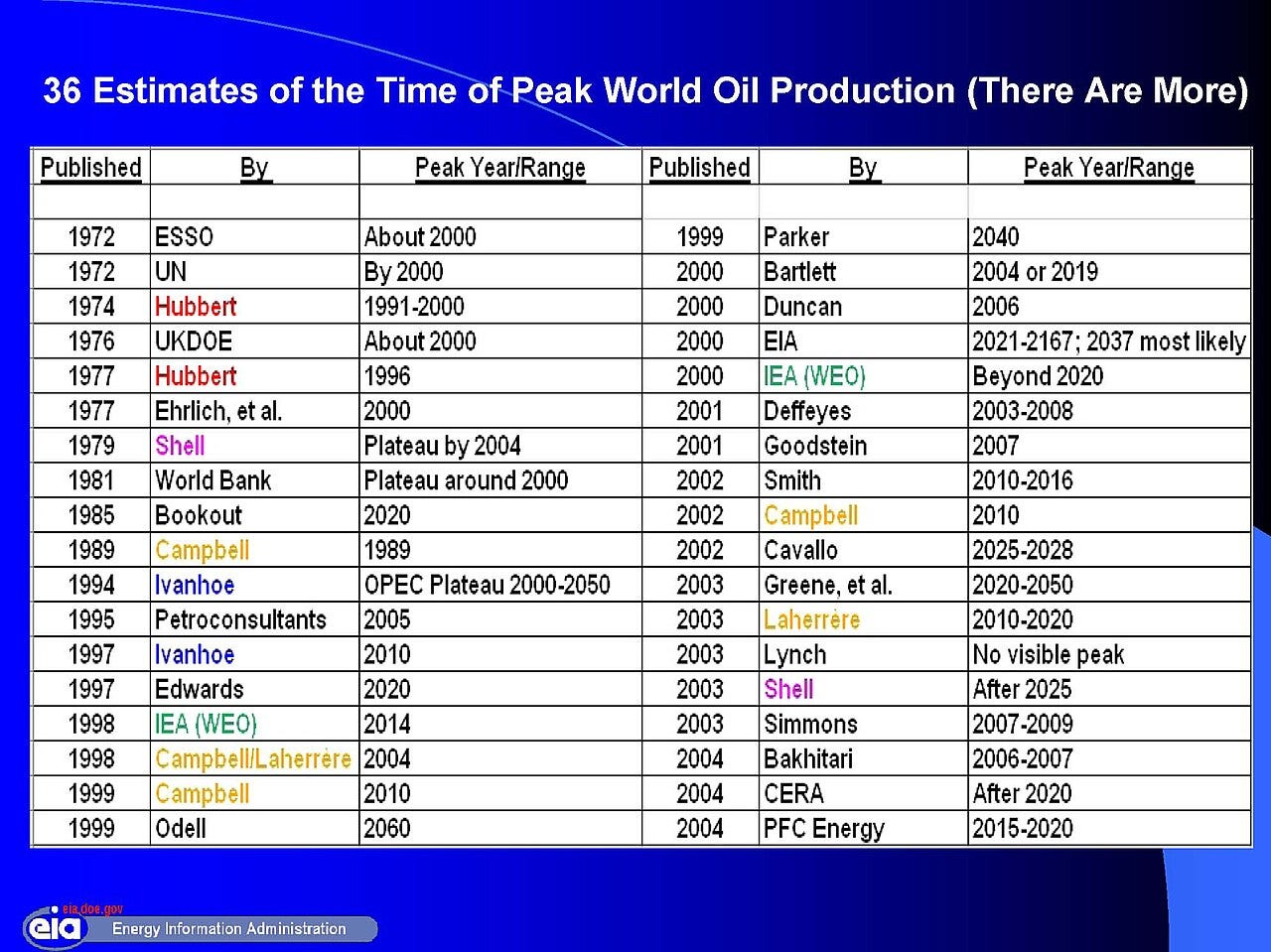
Not yet, despite numerous predictions that we should have hit this peak by now. It seems the supply of oil is somewhat elastic. From Wikipedia, a chart of past predictions for when oil output would peak. Oops. Current predictions are for a peak between 2030 and 2050. We’ll see.
Broadly speaking, however, it does look like in the OECD we have reached Peak Car on several metrics, while in the Developing World we seem to be nowhere near any peak.
And I haven’t researched this yet, but to the extent DoorDash (e.g.) displaces not just trips out to restaurants but meals prepared at home, food delivery may increase VMT.