
We didn't start the fire...
... but nor are we putting it out!

Apologies to Billy Joel.1 And thanks to Marginal Revolution for the referral to David Oks, who wrote about why American ambulance rides are so expensive.2 David’s post led naturally from ambulance services to fire-fighting services, and thus to fire departments, and thus to firetrucks — and thus the relevance to the vehicle-oriented Substack you are currently reading.
Preliminaries now complete!
Any of you who are parents or grandparents will note the fascination young children have with special-purpose vehicles. Something about heavy metal and loud noises and complex machinery I guess. It seems to start with garbage trucks3, or maybe tractors, but moves pretty quickly to firetrucks, who add the allure of sirens, flashing lights, and competent people in cool coats and helmets hanging off the outside of a vehicle (which is very thrilling to American kids who spend all their car time strapped into massive child seats4).
Anyway, Mr. Oks in his essay wrote that ambulance services (in the USA), in the past, tended to be run mostly by funeral homes. This is a clear example of business synergy: a hearse has space for a person lying down, whether among the living or not, and thus in the 1950s and 60s the difference between a hearse and an ambulance was basically just the paint scheme and maybe a red light:
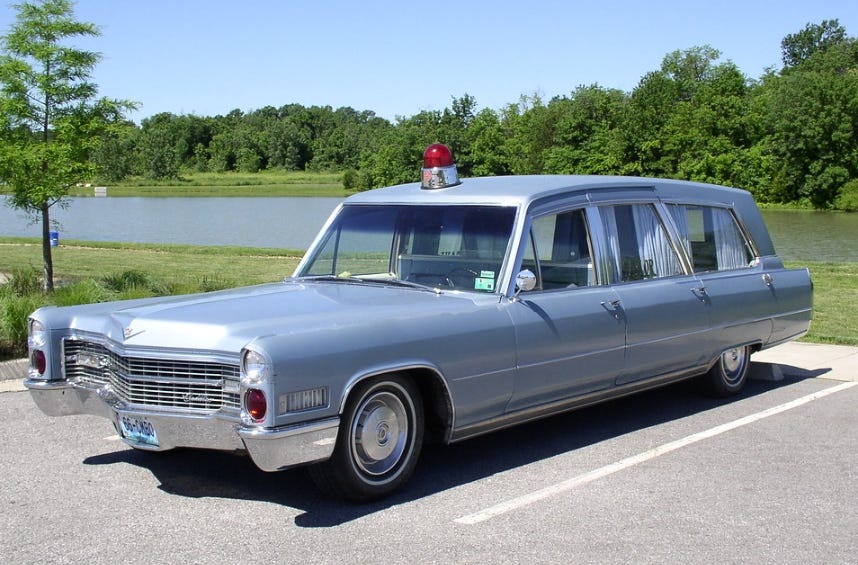
Image source.
(I do have to point out (just kidding!) the implicit conflict of interest, wherein during an especially bumpy ride to the hospital, Mr. Smith on the stretcher out back might suddenly convert from a hospital patient to a funeral home client: “Um, Phil, slow down, I think we can just head back to Serenity Acres now… there’s no rush….”)
But things began to change by 1970 or so. On the one hand, Americans were increasingly angry about how many people were not surviving an emergency ambulance ride, and on the other hand mobile trauma-care technology was developing that could improve that ride’s survivability rate. The EMS (emergency medical services) industry emerged, in which paramedics - people who weren’t doctors but who were highly trained in the required medical procedures - could use the new tech while the ambulance was still moving.
As Oks writes, “The funeral homes, facing new standards5 and no way to profit from meeting them, fled the industry. … In the 1980s, fire departments began to enter the business. They had fewer and fewer fires to fight, thanks to better building codes and the diffusion of smoke detectors; and they needed to justify their generous municipal budgets. Soon, many fire departments were EMS agencies in everything but name.”
Which brings us to our chart. This shows reported fire department “runs” in 2020 (I can’t find newer data) by incident type, from this report. It is up to you, readers, to guess which incident type is actually FIRES. The causes of course sum to 100%. Are fire departments indeed now EMS agencies in everything but name?
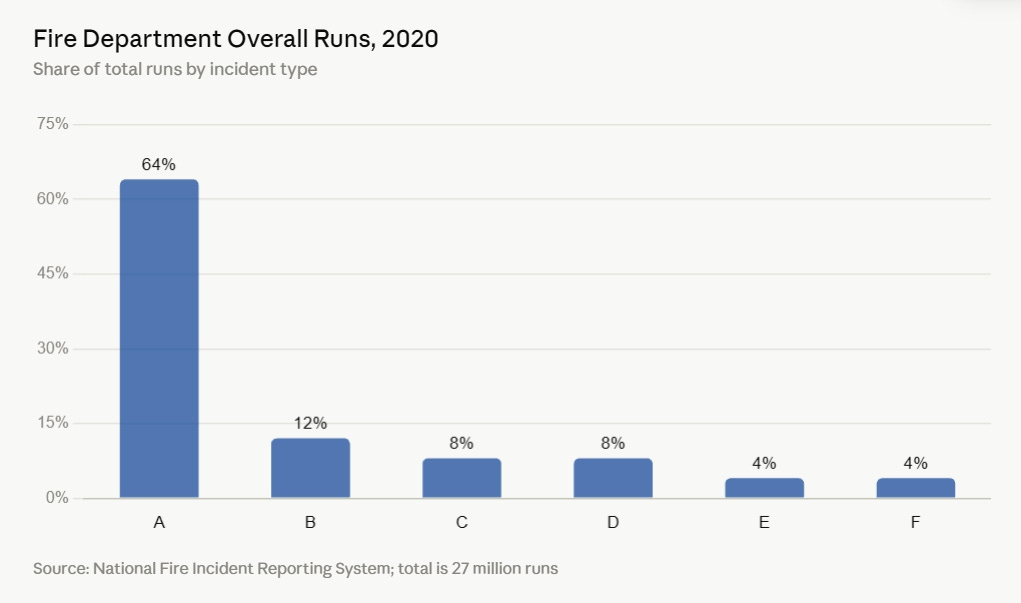
The answer: yes. E is runs carried out for fire-fighting. Only 4% of the time that you see the local fire department’s doors swing open and a vehicle launch out onto the street, lights flashing and sirens blaring - is it for what turns out to be a fire. Indeed, the local fire department really is now an the EMS department, as EMS work is (you guessed it) column A, at 64%.
I’m not saying this is a bad thing! It’s wonderful that houses don’t burn down as often as they did, and it’s wonderful that a trained medical professional can be treating you and relaying your vital signs to the ER while you are on the way there. But the 2-year-old version of myself would be disappointed to learn that every run doesn’t involve running up tall ladders, wrangling powerful cascades of water from massive hoses, and using axes to bust in and rescue trapped families.
So, one of the truly iconic vehicles on American roads, the firetruck, is no longer the star of the local fire department. It’s doing good work, yes, but not the same work, and not as much work as the new actor on the stage, the EMS van. Oh well.
Of course I hear you clamoring, “What about the other columns?” Interesting stuff here. Column C, at 8%, is false alarms. Column D, also 8%, is service calls, defined in the source report as “incidents involving a person in distress, water problem, smoke or odor problem, animal problem or rescue, public service assistance,” etc. So the classic “getting the cat down from a tree” I guess falls here. E, at 4%, is for hazardous conditions like chemical spills and bomb removal (!), where no fire is involved. F is an all-other category including responses to natural disasters.
So what about B, at 12%? This involves a special term of art: "good intent calls.” These lie in the gray zone between false alarms and active incidents, such as runs dispatched and then canceled en route, controlled burning, steam or other gas mistaken for smoke, and hazardous materials release claimed (but no hazardous condition found). I do like the term. I remember years ago reading in the local paper (remember those?), in the Police Blotter section (remember those?) the local FD reporting a “good intent” call to a local person who turned out to be concerned that the telephone wires between the poles on her street were “hanging lower than usual.”
No worries, we all survived.
And to my readers, for the incredibly poor timing of this post, given that many of you will be looking at this while under a pall of smoke from Canadian (and a few American) wildfires.
Of course, there is an automotive angle here as well, in that one can hypothesize that car dealers - who do a lot of business outdoors - might be affected by the smoke. The economists over at Anderson Economic Group are of course already on the job here, trying to estimate the damage of the smoke event to all sorts of outdoor-dependent businesses. To quote them (edited for brevity):
Wildfires that began in Canada in June started seriously affecting the United States on July 14, sending large plumes of smoke and particulates across much of the United States… The acrid smoke and hazardous particulates have already caused losses of income and other damages that number in the many billions of dollars… The company identified the following loss events that have already been confirmed as of mid-day Friday July 17:
Closures of amusement parks
Cancellation of outside events and event spaces, ranging from professional sports events to regional fairs
Closures of health clubs
Closures of public parks
Warnings about working outside, exercising outside, or sitting outside,
In addition, the acrid smoke and widespread warnings are likely to substantially impact …. businesses that often serve their customers outdoors, including many car dealers, auction houses, and a wide range of businesses in agriculture, travel, and tourism.
“We can already observe the closure of many parks, businesses serving customers outdoors, and health clubs where people would otherwise be exercising, relaxing, working or just enjoying the outdoors,” said Richard Melstrom, an environmental economist at Anderson Economic Group. “Our preliminary estimates, even with the early and incomplete data available today, indicate these losses are in the many billions of dollars.”
To estimate the scale of the economic losses with the partial information available as of mid-day Friday, the Anderson Economic Group economists looked at the geographic dispersion of high and hazardous levels of smoke, using data from the NOAA, EPA Airnow monitors and secondary sources; economic indicators of population and income across these areas; industry factors particularly those indicating sensitivity to closures due to hazardous air quality; economic literature on past identifiable losses from wildfires; and specific recorded instances of closures that were publicly known as of Friday. Our current estimate focuses on 102 million residents across a 10-state area.”
See his fascinating post.
If you’re still very young at heart, stop by here and pick up a used one at auction, cheap! Proof once again that there is no niche within the sprawling automotive industry too small to not have its own separate ecosystem of dealers, traders, service technicians, and more.
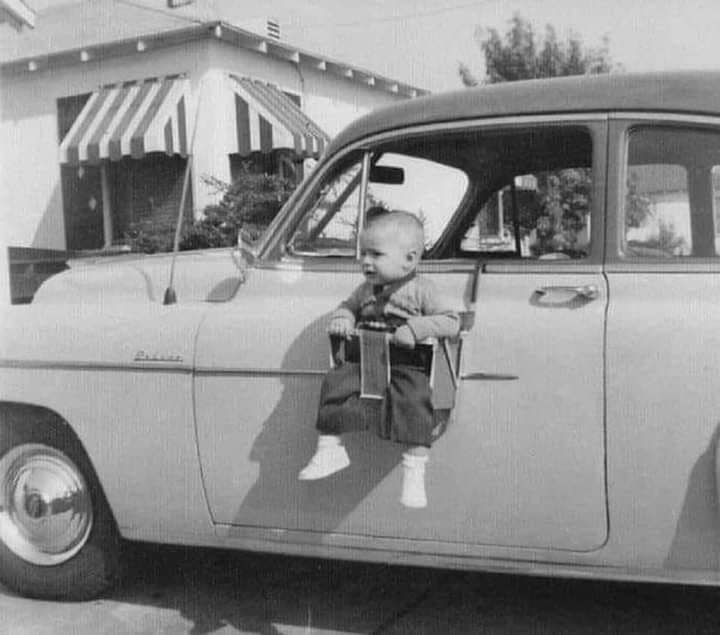
As regards kids in cars, safety standards have, um, evolved. See here for example. And can anyone explain exactly what is going on with this young lad? I don’t think he is a firefighter…

Meaning, the costs of having on staff trained paramedics (rather than just good ol’ Phil driving the hearse-bulance), and of investing in the onboard technology.