
Four of Five
In brief praise of the roundabout. (Not the song by Yes.)

If you spend any time driving in the UK you will notice one major distinction between the British road system and the American version. (Not counting the Scottish single-track-road-with-passing-place “let’s joust!” thrill ride.) This would be the prevalence of the roundabout. Referred to in the USA as “traffic circle” or “rotary.” They got ‘em, but we - broadly speaking - do not.
And this is a shame. While the automotive world is entranced by digital “tech-y” solutions to road safety (connected cars, autonomous vehicles, etc.) this very old-fashioned analog technology is a well-proven life-saver. Relative to what I’ll call traditional intersections (e.g. two roads crossing, controlled by traffic lights), they experience fewer car crashes.
Why is this? Several reasons:
Lower speeds (and thus lower impact energy) are engineered into the geometry: curved paths result in operating speeds on the order of 15–25 mph through the roundabout, dramatically reducing the risk of fatal or serious collisions. And this is usually without any throughput loss: at or below capacity a roundabout, will generally carry as many cars per hour as the traditional intersection, though at very heavy loads the latter may do slightly better.
Far fewer and different conflict points, especially far fewer crossing conflicts: you can’t “T-bone” someone in a roundabout. Merging and diverging traffic paths lead to glancing rather than direct collisions. Not to mention elimination of the unprotected left turn, which is the source of so much angst and damage (ask robotaxi programmers!).
The roundabout eliminates the deadly “run the red light” failure mode, replacing it with the milder “failure to yield” mode. Of course.
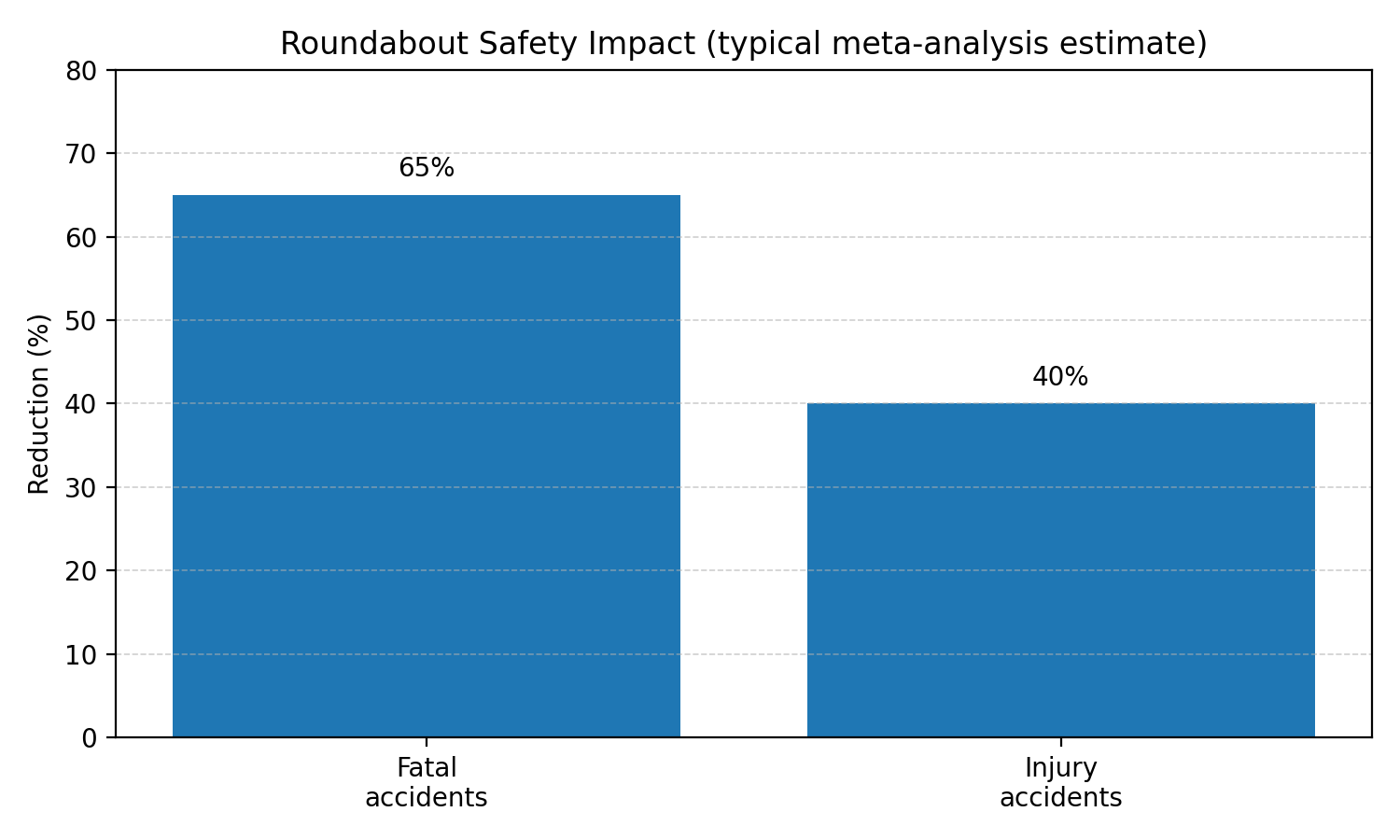
What does this add up to, in quantitative terms? A couple of extensive meta-analyses (of multiple studies)1 yields this rule-of-thumb chart:
If they are so much safer, why don’t we in the colonies use them, much? There are a few historical reasons, having to do with land-use considerations (roundabouts tend to use more space, though the USA would seem to have more of this than the UK), public skepticism in America (since roundabouts require some cooperation among drivers, are they somehow considered - oh no! - socialist!?), engineering society preferences, and much more, but I’ll leave these to the reader to research if interested. And there is this significant cultural reference point.
But to cut to the chase, using some very broad assumptions about numbers and types of intersections, my calculations conclude that a nationwide replacement of a majority of traditional intersections with roundabouts - wildly infeasible as it would be - would save perhaps 5,000 lives out of our average 40,000 killed annually on our roads2.
All without building one robot or writing one line of code. Not sexy, no - but effective.
E.g. “Road safety effects of roundabouts: A meta-analysis,” by R. Elvik.
Some 30% of all our traffic fatalities occur in intersections. And as an alert reader noticed, 30% of 40,000 is 12,000, and a 65% reduction in that would be 8,000, not 5,000. I completely unscientifically knocked down the 8,000 by 40% by assuming 40% of intersections could never be converted. To use the technical term, it was a SWAG.